Acne Scar Treatment Options: TCA CROSS, Subcision & Microneedling
Last updated: October 13 2026
Acne scars can look similar on the surface while being very different underneath. A narrow ice pick scar, a rolling depression tethered by fibrous tissue, and a shallow boxcar scar do not involve the skin in exactly the same way. That is why the treatment that works well for one type of acne scar may have limited benefit for another.
At Castle Dermatology in Tarzana, acne scar treatment is based on the type, depth, and pattern of scarring rather than relying on a single procedure for every patient. Treatments such as TCA CROSS, subcision, microneedling, and RF microneedling address different aspects of atrophic acne scarring and may be used individually or as part of a combination treatment plan.
Understanding what is causing the uneven texture is an important first step. Some scars extend deeply into the skin, while others are held down by fibrous bands or involve broader areas of collagen loss. Identifying those differences helps determine which treatment approach makes the most sense.
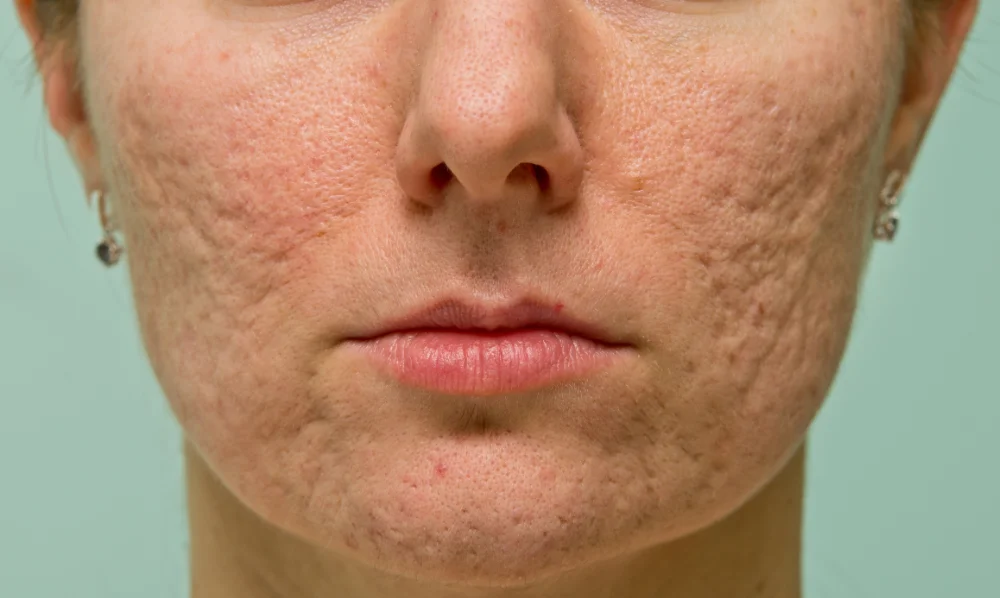
Understanding Acne Scar Types: Why One Procedure Is Not Enough
Atrophic acne scars are commonly classified as ice pick, rolling, or boxcar scars. Many patients have more than one type, which is one reason acne scar treatment often needs to be individualized.
Ice Pick Scars: Deep, Narrow Depressions
Ice pick scars are narrow depressions that extend relatively deeply into the skin. They often appear as small pits or openings but can involve deeper tissue than their surface appearance suggests.
Because these scars are narrow and deep, treatments that primarily address broader areas of surface texture may have limited benefit. More focal treatments, including TCA CROSS, may be considered depending on the depth and shape of the individual scars.
Rolling Scars: Depressions Caused by Tethering
Rolling scars are broader depressions with gently sloping edges that can give the skin a wavy or uneven appearance. In some cases, fibrous bands beneath the skin tether the scar downward and contribute to the depression.
When tethering is present, treatments directed only at the skin’s surface may not fully address the underlying problem. Subcision may be considered to release these bands before or alongside treatments aimed at improving the skin’s texture.
Boxcar Scars: Defined Depressions With Sharper Edges
Boxcar scars are round or oval depressions with more clearly defined edges. They can vary considerably in width and depth.
Shallower boxcar scars may respond to treatments that stimulate collagen remodeling across a broader area, including microneedling or RF microneedling. Deeper boxcar scars may require a different or combined approach depending on their shape and depth.
TCA CROSS: Targeted Treatment for Deep, Narrow Scars
TCA CROSS, short for chemical reconstruction of skin scars, is a focused treatment used primarily for deep, narrow acne scars. Rather than applying a chemical peel across a larger area of skin, the dermatologist places a small amount of high-concentration trichloroacetic acid directly inside individual scars.
The acid creates a controlled injury within the scar, triggering a healing response and collagen remodeling over time. This approach can be particularly useful for ice pick scars and certain narrow, deep boxcar scars that may not respond as well to treatments designed for broader areas of uneven texture.
Because TCA CROSS treats individual scars rather than the entire skin surface, careful application is important. Scar depth, skin tone, pigmentation history, and the overall pattern of acne scarring can all affect whether the treatment is appropriate and how it should be performed.
Immediately after treatment, the treated areas may temporarily turn white, an effect known as frosting. Small crusts or scabs can then develop over the following days as the skin heals. These areas should be allowed to heal naturally rather than being picked or removed.
Improvement occurs gradually as the treated scars heal and collagen remodels. Some patients need more than one treatment, and the number and spacing of sessions depend on the scars being treated, skin response, and the dermatologist’s treatment plan.
How Subcision Addresses Tethered Acne Scars
Subcision is an in-office procedure used primarily for depressed acne scars that are tethered to deeper tissue. It can be particularly useful for certain rolling scars.
During the procedure, a needle or cannula is introduced beneath the scar to release fibrous bands that are pulling the skin downward. Releasing these bands reduces the underlying tethering and may allow the depression to become less noticeable as the area heals.
Local anesthesia is used to improve comfort during treatment. Patients may still notice pressure or movement during the procedure, followed by temporary soreness, swelling, or bruising afterward.
The healing response following subcision can also contribute to collagen formation and gradual improvement in the contour of the treated area. Depending on the scar pattern, subcision may be combined with other treatments that address remaining depressions or uneven surface texture.
Subcision is not appropriate for every depressed acne scar. A dermatologist needs to determine whether tethering is actually contributing to the scar before recommending the procedure.
Microneedling and RF Microneedling for Acne Scars
Microneedling takes a different approach to acne scar treatment. Instead of targeting an individual deep scar or releasing a tether beneath the skin, it creates controlled micro-injuries across the treatment area to stimulate the skin’s wound-healing response and collagen remodeling.
Over time, this process may soften the appearance of certain atrophic scars and improve broader areas of uneven texture. Microneedling may be particularly useful when a patient has shallower scars or textural changes affecting a larger area.
Because it addresses a broader treatment field, microneedling may also complement more targeted procedures such as TCA CROSS or subcision.
How Is RF Microneedling Different?
RF microneedling combines controlled needle penetration with radiofrequency energy delivered into the skin. The treatment is designed to stimulate tissue remodeling through both the microneedling process and controlled thermal energy.
Depending on the patient’s scars, skin characteristics, and treatment goals, RF microneedling may be considered for certain acne scars and areas of uneven texture.
Castle Dermatology may use technologies such as Potenza RF microneedling when appropriate for the patient’s treatment plan. Device settings, treatment depth, and energy levels should be selected according to the individual patient’s skin and scar characteristics.
TCA CROSS vs. Subcision vs. Microneedling: What's the Difference?
These procedures are not interchangeable. Each addresses a different component of acne scarring.
| TCA CROSS | Subcision | Microneedling / RF Microneedling | |
|---|---|---|---|
| Common treatment target | Ice pick and certain narrow, deep scars | Tethered rolling and depressed scars | Certain boxcar scars and broader uneven texture |
| How it works | Focal chemical treatment stimulates remodeling within individual scars | Releases fibrous bands beneath tethered scars | Creates controlled micro-injuries, with RF devices also delivering thermal energy |
| Comfort measures | Depends on treatment plan | Local anesthesia | Topical numbing is commonly used |
| Common recovery considerations | Temporary frosting followed by small crusts or scabs | Temporary swelling, tenderness, or bruising | Temporary redness, swelling, sensitivity, or dryness |
| Number of treatments | Varies by scar depth and response | Varies by the extent of tethering and response | Varies by scar pattern, treatment goals, and response |
The important distinction is what is causing the scar. A deep ice pick scar may need a focal treatment, while a rolling scar held down by fibrous tissue may need the tethering addressed first. Broader areas of uneven texture may benefit from collagen-remodeling treatments such as microneedling.
Why Acne Scar Treatments Are Often Combined
Many people do not have just one type of acne scar. A patient may have ice pick scars on one area of the cheek, rolling scars in another, and shallower boxcar depressions elsewhere.
In these cases, relying on one procedure for the entire face may not address every component of the scarring. A dermatologist may instead recommend different treatments for different scar types.
For example, tethered rolling scars may be treated with subcision to address deeper fibrous bands, while TCA CROSS may be used for individual ice pick scars. Microneedling or RF microneedling may then be considered for broader areas of uneven texture.
The order and timing of these procedures depend on the patient’s scar pattern and treatment plan. They may be staged rather than performed at the same visit, allowing the dermatologist to evaluate healing and response before proceeding with the next treatment.
What About Acne Scar Treatment for Darker Skin Tones?
Skin tone is an important consideration when planning acne scar treatment because some procedures can trigger post-inflammatory hyperpigmentation, particularly in patients who are prone to pigment changes after inflammation or injury.
Having a darker skin tone does not automatically mean acne scar treatment is off limits. It does mean that treatment selection, technique, settings, and aftercare require careful consideration.
A dermatologist can evaluate your skin type, history of pigmentation, scar pattern, previous treatments, and the procedure being considered before recommending an approach. Sun protection and appropriate aftercare are also particularly important when the skin is healing.
What Should You Expect After Acne Scar Treatment?
Recovery depends on the procedure performed rather than following one universal timeline.
After TCA CROSS, individual treatment sites may initially appear white or frosted before small crusts develop. These should be left to heal naturally.
After subcision, temporary swelling, tenderness, and bruising can occur because the treatment works beneath the skin to release tethering bands.
After microneedling or RF microneedling, patients may experience temporary redness, swelling, sensitivity, or dryness in the treated area.
Your dermatologist will provide procedure-specific aftercare instructions based on the treatment performed. In general, patients should avoid picking or irritating healing skin and follow recommendations for gentle skincare and sun protection.
It is also important to remember that acne scar improvement is not immediate. Treatments that rely on healing and collagen remodeling produce changes gradually, and the amount of improvement varies among patients.
Why Choose Castle Dermatology for Acne Scar Treatment?
Successful acne scar treatment begins with identifying what type of scarring is actually present. The treatment that makes sense for a tethered rolling scar may be very different from the approach used for an ice pick scar.
At Castle Dermatology, treatment planning begins with an evaluation of the patient’s skin and acne scar pattern. Factors such as scar type, depth, distribution, skin tone, previous treatments, and treatment goals can all influence which approach is recommended.
Because patients frequently have a combination of scar types, treatment can be planned around the individual pattern rather than applying the same procedure to every scar.
Castle Dermatology’s board-certified dermatologists can determine whether TCA CROSS, subcision, microneedling, RF microneedling, or another approach may be appropriate after evaluating the skin in person.
Frequently Asked Questions About Acne Scar Treatment
Which acne scar treatment is best for my skin?
The most appropriate treatment depends on the type, depth, and pattern of your scars. TCA CROSS may be considered for ice pick and certain narrow, deep scars, while subcision may help when rolling scars are tethered by fibrous bands. Microneedling may be useful for certain shallow atrophic scars and broader texture concerns. Many patients have more than one scar type, so treatment may involve a combination of approaches.
Is subcision for acne scars painful?
Local anesthesia is used to make subcision more comfortable. You may still feel pressure or movement as the fibrous bands are released. Temporary soreness, swelling, and bruising can occur afterward, and the amount of discomfort varies from patient to patient.
How many TCA CROSS or microneedling treatments will I need?
The number and spacing of treatments depend on the procedure, scar depth, skin type, treatment response, and overall treatment plan. Your dermatologist can provide an initial estimate after evaluating your scars and adjust the plan based on how your skin responds.
What is the downtime after TCA CROSS and microneedling?
Recovery differs between the two treatments. TCA CROSS can cause temporary frosting followed by small crusts at the individual treatment sites. Microneedling commonly causes temporary redness, swelling, sensitivity, or dryness. Your dermatologist can explain what to expect based on the treatment depth and technique planned for you.
Can darker skin tones undergo TCA CROSS and subcision?
Some patients with darker skin tones may be candidates for TCA CROSS or subcision, but treatment requires careful evaluation because post-inflammatory hyperpigmentation can occur. Your dermatologist will consider your skin type, pigmentation history, scar pattern, and other factors before recommending treatment.
How long do acne scar treatment results last?
Improvements from acne scar procedures can be long-lasting because treatments such as subcision, TCA CROSS, and microneedling are intended to remodel existing scar tissue rather than temporarily conceal it. Results vary, however, and no procedure can guarantee permanent correction of a scar. Natural aging, new acne, and individual healing responses can also affect the skin’s appearance over time.
Can one treatment fix every type of acne scar?
Usually, treatment selection depends on the individual scar pattern. Ice pick, rolling, and boxcar scars have different structural characteristics, so one procedure may work better for certain scars than others. When several scar types are present, a dermatologist may recommend a combination or staged treatment plan.
How do I know whether I need TCA CROSS, subcision, or microneedling?
The appearance of a scar provides some clues, but an in-person skin evaluation is the best way to determine what is contributing to the depression. Your dermatologist can assess whether a scar is deep and narrow, tethered to deeper tissue, or part of a broader textural concern and recommend treatment accordingly.
Schedule Your Acne Scar Consultation at Castle Dermatology
Acne scars do not all respond to the same treatment. The most useful starting point is determining which types of scars you have, how deeply they involve the skin, and whether underlying tethering is contributing to the uneven texture.
If you are considering treatment for persistent acne scars, schedule a consultation with a board-certified dermatologist at Castle Dermatology in Tarzana. Your dermatologist can evaluate your scar pattern and discuss which treatment or combination of treatments may be appropriate for your skin.
This article provides general medical information and is not a substitute for individualized medical advice. Treatment recommendations, results, and recovery vary by patient.